Fitness · Footwear Guide
Can You Wear Running Shoes for Pickleball? Court Shoes vs. Running Shoes
Affiliate disclosure: This article may contain affiliate links. CAH Health may earn a commission from qualifying purchases at no additional cost to you. Learn more.
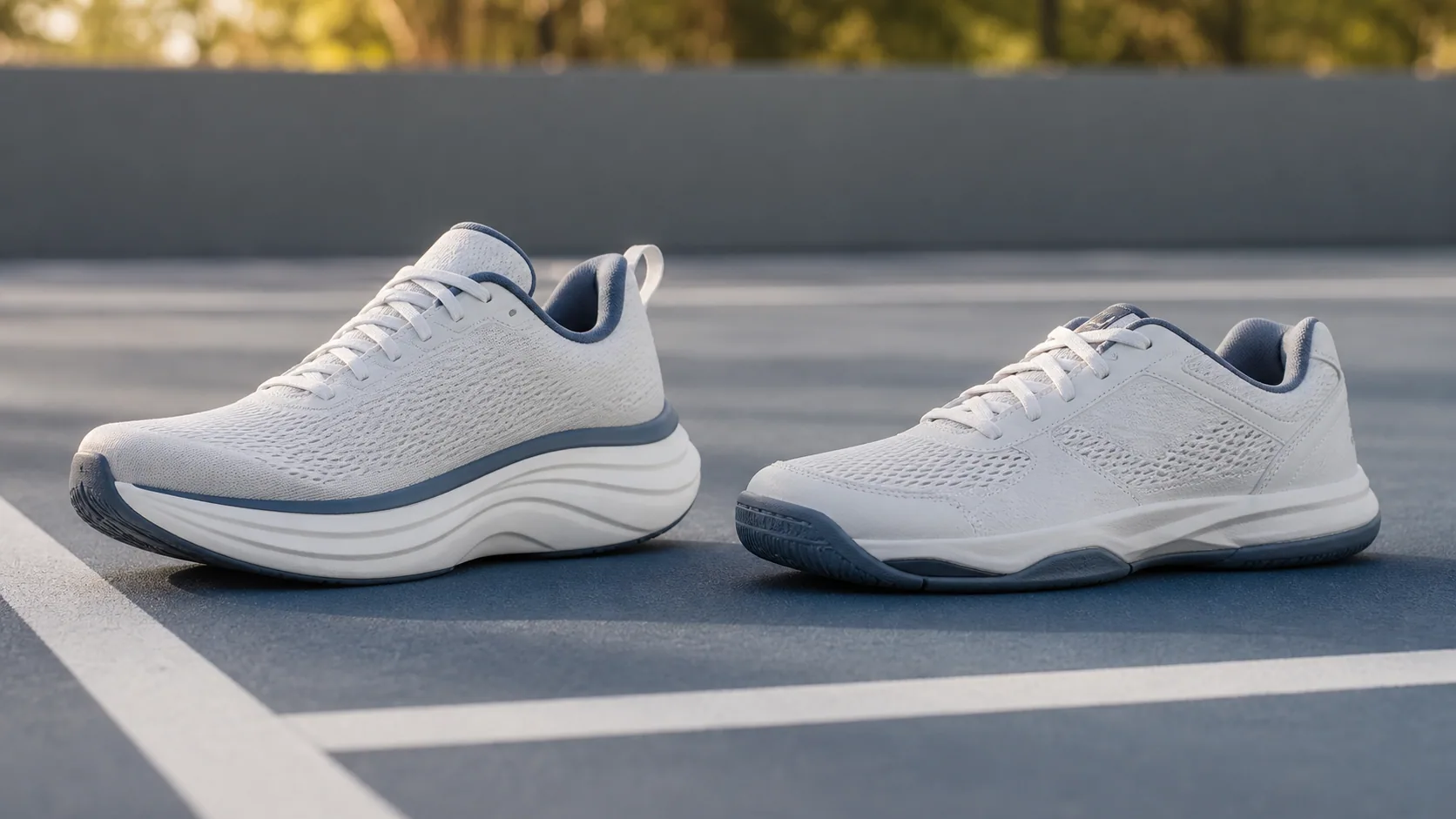
Short answer: running shoes are not the best choice for regular pickleball. They are built primarily for repeated forward motion, while pickleball asks you to shuffle, stop, pivot, and change direction. A stable tennis, pickleball, squash, or other court shoe is usually the more appropriate option.
That does not mean a running shoe automatically causes an injury, or that a shoe labeled “pickleball” is automatically good. It means the movement pattern and the construction of the shoe should match. Fit, court surface, your playing frequency, and the condition of the outsole matter too.
Running shoes and court shoes at a glance
| Feature | Running shoe | Pickleball or court shoe |
|---|---|---|
| Primary movement | Forward, heel-to-toe motion | Side-to-side cuts, pivots, stops, and short sprints |
| Platform | Often taller and more curved | Usually lower, flatter, and wider |
| Cushioning | Often soft and impact-focused | Balanced with court feel and lateral stability |
| Upper support | Designed around forward flex | Reinforced for multidirectional movement |
| Outsole | Road or trail traction | Court-specific grip and abrasion resistance |
Why running shoes feel comfortable—but can be the wrong tool
Modern running shoes can feel excellent the moment you put them on. Many use a soft midsole, a curved profile, and a generous stack of foam to make forward strides feel smooth. Those are useful running features, but pickleball is not a series of straight-line strides.
During a rally, your feet repeatedly load the edges of the shoe as you move laterally. A high, soft platform can feel less planted during those movements. A road-running outsole may also wear quickly on an abrasive hard court, particularly around the forefoot and toe where players drag and push off.
Sports-medicine specialists at Hospital for Special Surgery recommend a stable, flat court shoe for pickleball and note that it does not have to carry a pickleball-specific label. Tennis and squash court shoes can also fit the movement demands. The American Academy of Orthopaedic Surgeons likewise notes that athletic shoes are designed differently for the stability and flexibility demands of different sports.
What a useful pickleball shoe should provide
1. A stable base
Look for a platform that feels planted when you shuffle in both directions. The shoe should not feel as though your foot is rolling over the edge of the midsole. Stability is about the complete design—not simply whether the collar is low or high.
2. Secure heel and midfoot hold
Your heel should stay seated when you stop and change direction. The lacing system should hold the midfoot comfortably without numbness or pressure. AAOS guidance highlights the heel counter and vamp—the part of the upper over the middle of the foot—as important contributors to shoe control and fit.
3. Enough toe room
A court shoe should be secure, not cramped. Your toes need room to lie naturally without being pinched or pushed together. Try shoes on while standing, and test a few controlled side steps rather than judging the fit only while seated.
4. An outsole matched to the surface
Outdoor hard courts reward durable rubber. Smooth indoor gym floors often call for a clean, non-marking outsole with dependable grip. An “indoor” venue can still use an acrylic hard-court surface, so inspect the actual floor before choosing. Our guide to indoor vs. outdoor pickleball shoes explains the distinction.
Can you wear running shoes for one casual game?
People often play their first recreational game in whatever athletic shoes they own. If that is your situation, keep the pace controlled, make sure the outsole is clean and not worn smooth, and pay attention to how stable the shoe feels during gentle side steps. Stop if you feel slipping, foot movement inside the shoe, or pain.
If you plan to keep playing, a court shoe is a sensible early equipment upgrade. You do not necessarily need the most expensive model. A well-fitting tennis or pickleball shoe with a stable base is more useful than a premium shoe that does not match your foot.
A five-minute fitting checklist
- Measure both length and width; fit the larger foot.
- Check that your toes are not pinched or overlapping.
- Make sure the heel stays in place during controlled side steps.
- Confirm the shoe bends near the toe box, not through the arch.
- Test the shoes with the socks you use on court.
- Do not rely on an uncomfortable shoe “breaking in.”
Are tennis shoes good for pickleball?
In many cases, yes. Tennis shoes are made for the same broad family of hard stops, lateral movement, and court abrasion. Differences between individual models usually matter more than the category name. Read our pickleball shoes vs. tennis shoes comparison before choosing.
The bottom line
Running shoes are optimized for running. Pickleball rewards a lower, more stable court platform with lateral support and surface-appropriate traction. Choose by construction and fit—not by marketing language alone—and replace shoes when the outsole or support is visibly worn. Footwear cannot prevent every injury, but it should not work against the way your sport asks you to move.
Affiliate link
Sources and further reading
- Hospital for Special Surgery: Pickleball injury-prevention tips
- AAOS OrthoInfo: Shoes—Finding the Right Fit
- AAOS: Pickleball Injury Prevention Tips
This article provides general educational information, not medical or individualized footwear advice. Consult a qualified professional if you have persistent pain, instability, or a previous injury.